import pandas as pd
import numpy as np
import wooldridge
import statsmodels.formula.api as smf
import matplotlib.pyplot as plt
wooldridge.data() J.M. Wooldridge (2019) Introductory Econometrics: A Modern Approach,
Cengage Learning, 6th edition.
401k 401ksubs admnrev affairs airfare
alcohol apple approval athlet1 athlet2
attend audit barium beauty benefits
beveridge big9salary bwght bwght2 campus
card catholic cement census2000 ceosal1
ceosal2 charity consump corn countymurders
cps78_85 cps91 crime1 crime2 crime3
crime4 discrim driving earns econmath
elem94_95 engin expendshares ezanders ezunem
fair fertil1 fertil2 fertil3 fish
fringe gpa1 gpa2 gpa3 happiness
hprice1 hprice2 hprice3 hseinv htv
infmrt injury intdef intqrt inven
jtrain jtrain2 jtrain3 kielmc lawsch85
loanapp lowbrth mathpnl meap00_01 meap01
meap93 meapsingle minwage mlb1 mroz
murder nbasal nyse okun openness
pension phillips pntsprd prison prminwge
rdchem rdtelec recid rental return
saving sleep75 slp75_81 smoke traffic1
traffic2 twoyear volat vote1 vote2
voucher wage1 wage2 wagepan wageprc
wine
Examples
wage1 = wooldridge.data("wage1")
meap93 = wooldridge.data("meap93")
gpa1 = wooldridge.data("gpa1")
campus = wooldridge.data("campus")
hprice2 = wooldridge.data("hprice2")
k401 = wooldridge.data("401k")
jtrain = wooldridge.data("jtrain")
rdchem = wooldridge.data("rdchem")
bwght = wooldridge.data("bwght")
4.1 Hourly Wage Equation
wooldridge.data("wage1", description=True)name of dataset: wage1
no of variables: 24
no of observations: 526
+----------+---------------------------------+
| variable | label |
+----------+---------------------------------+
| wage | average hourly earnings |
| educ | years of education |
| exper | years potential experience |
| tenure | years with current employer |
| nonwhite | =1 if nonwhite |
| female | =1 if female |
| married | =1 if married |
| numdep | number of dependents |
| smsa | =1 if live in SMSA |
| northcen | =1 if live in north central U.S |
| south | =1 if live in southern region |
| west | =1 if live in western region |
| construc | =1 if work in construc. indus. |
| ndurman | =1 if in nondur. manuf. indus. |
| trcommpu | =1 if in trans, commun, pub ut |
| trade | =1 if in wholesale or retail |
| services | =1 if in services indus. |
| profserv | =1 if in prof. serv. indus. |
| profocc | =1 if in profess. occupation |
| clerocc | =1 if in clerical occupation |
| servocc | =1 if in service occupation |
| lwage | log(wage) |
| expersq | exper^2 |
| tenursq | tenure^2 |
+----------+---------------------------------+
These are data from the 1976 Current Population Survey, collected by
Henry Farber when he and I were colleagues at MIT in 1988.
model01 = smf.ols("np.log(wage) ~ educ + exper + tenure", data=wage1).fit()
model01.summary2().tables[1].iloc[:, :2]We got exper has with a standard error of 0.0017
SO the t statistic is , t critical is 1.645 at 5% and 2.326 at 1%,
t statistic > t critical we reject the null hypothesis at 1% significance level
is greater than zero
4.2 Student Performance And School Size
wooldridge.data("meap93", description=True)name of dataset: meap93
no of variables: 17
no of observations: 408
+----------+---------------------------------+
| variable | label |
+----------+---------------------------------+
| lnchprg | perc of studs in sch lnch prog |
| enroll | school enrollment |
| staff | staff per 1000 students |
| expend | expend. per stud, $ |
| salary | avg. teacher salary, $ |
| benefits | avg. teacher benefits, $ |
| droprate | school dropout rate, perc |
| gradrate | school graduation rate, perc |
| math10 | perc studs passing MEAP math |
| sci11 | perc studs passing MEAP science |
| totcomp | salary + benefits |
| ltotcomp | log(totcomp) |
| lexpend | log of expend |
| lenroll | log(enroll) |
| lstaff | log(staff) |
| bensal | benefits/salary |
| lsalary | log(salary) |
+----------+---------------------------------+
I collected these data from the old Michigan Department of Education
web site. See MATHPNL.RAW for the current web site. I used data on
most high schools in the state of Michigan for 1993. I dropped some
high schools that had suspicious-looking data.
model02 = smf.ols("math10 ~ totcomp + staff + enroll", data=meap93).fit()
model02.summary2().tables[1].iloc[:, :2]It is believed that smaller schools are associated with higher test scores
We get similar to the conjecture
The critical t is at degree of freedoms
t statistic is we fail to reject
school size is not statistically significant
model022 = smf.ols("math10 ~ ltotcomp + lstaff + lenroll", data=meap93).fit()
model022.summary2().tables[1].iloc[:, :2]If we take level log form, we reject
If enrollment increases by 10%, math score is expected to decrease by 0.13 percentage points
model02.rsquared, model022.rsquared(np.float64(0.0540626230832697), np.float64(0.06537749365652679))level log model has higher so its better than level level model
4.3 Determinants of College GPA
wooldridge.data("gpa1", description=True)name of dataset: gpa1
no of variables: 29
no of observations: 141
+----------+--------------------------------+
| variable | label |
+----------+--------------------------------+
| age | in years |
| soph | =1 if sophomore |
| junior | =1 if junior |
| senior | =1 if senior |
| senior5 | =1 if fifth year senior |
| male | =1 if male |
| campus | =1 if live on campus |
| business | =1 if business major |
| engineer | =1 if engineering major |
| colGPA | MSU GPA |
| hsGPA | high school GPA |
| ACT | 'achievement' score |
| job19 | =1 if job <= 19 hours |
| job20 | =1 if job >= 20 hours |
| drive | =1 if drive to campus |
| bike | =1 if bicycle to campus |
| walk | =1 if walk to campus |
| voluntr | =1 if do volunteer work |
| PC | =1 of pers computer at sch |
| greek | =1 if fraternity or sorority |
| car | =1 if own car |
| siblings | =1 if have siblings |
| bgfriend | =1 if boy- or girlfriend |
| clubs | =1 if belong to MSU club |
| skipped | avg lectures missed per week |
| alcohol | avg # days per week drink alc. |
| gradMI | =1 if Michigan high school |
| fathcoll | =1 if father college grad |
| mothcoll | =1 if mother college grad |
+----------+--------------------------------+
Christopher Lemmon, a former MSU undergraduate, collected these data
from a survey he took of MSU students in Fall 1994.
model03 = smf.ols("colGPA ~ hsGPA + ACT + skipped", data=gpa1).fit()
model03.summary2().tables[1].iloc[:, :2]In two sided alternatives, 5% critical value is 1.96 at df = and 1% at 2.58
hsGPA has
ACT has small coefficient and is practically and statistically insignificant
skipped has statistically significant
4.4 Campus Crime and Enrollment
wooldridge.data("campus", description=True)name of dataset: campus
no of variables: 7
no of observations: 97
+----------+-----------------------+
| variable | label |
+----------+-----------------------+
| enroll | total enrollment |
| priv | =1 if private college |
| police | employed officers |
| crime | total campus crimes |
| lcrime | log(crime) |
| lenroll | log(enroll) |
| lpolice | log(police) |
+----------+-----------------------+
These data were collected by Daniel Martin, a former MSU
undergraduate, for a final project. They come from the FBI Uniform
Crime Reports and are for the year 1992.
model04 = smf.ols("lcrime ~ lenroll", data=campus).fit()
model04.summary2().tables[1].iloc[:, :2]We didn’t test for cuz its expected, is more interesting, if , then crime is a big problem on large campuses
enroll = np.linspace(0.000001, 2, 100)


crime_elastic_05 = np.exp(0.5 * np.log(enroll))  # β = 0.5
crime_elastic_1 = np.exp(1.0 * np.log(enroll))  # β = 1.0
crime_elastic_15 = np.exp(1.5 * np.log(enroll))  # β = 1.5

plt.figure(figsize=(10, 6))
plt.plot(enroll, crime_elastic_05, label=r"$\beta_1 = 0.5$", linestyle="--")
plt.plot(enroll, crime_elastic_1, label=r"$\beta_1 = 1$", linestyle="-")
plt.plot(enroll, crime_elastic_15, label=r"$\beta_1 = 1.5$", linestyle=":")

plt.xlabel("Enrollment")
plt.ylabel("Crime")
plt.title("Elasticity Models: log(Crime) ~ β * log(Enroll)")
plt.legend()
plt.grid(True)
plt.tight_layout()
plt.show()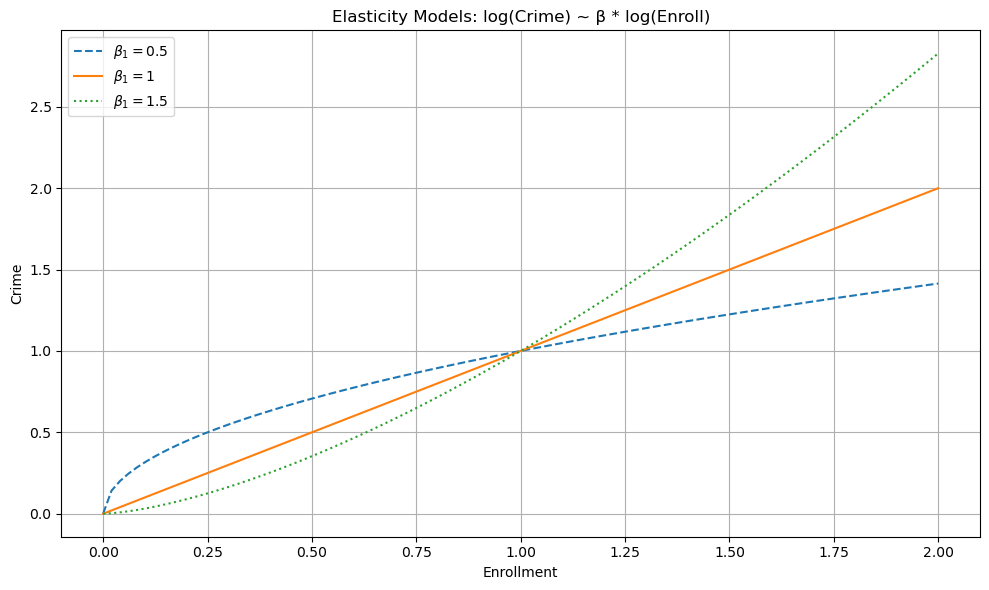
model04.t_test("lenroll = 1").tvalue[0]array([2.45736997])4.5 Housing Prices and Air Pollution
wooldridge.data("hprice2", description=True)name of dataset: hprice2
no of variables: 12
no of observations: 506
+----------+-------------------------------+
| variable | label |
+----------+-------------------------------+
| price | median housing price, $ |
| crime | crimes committed per capita |
| nox | nit ox concen; parts per 100m |
| rooms | avg number of rooms |
| dist | wght dist to 5 employ centers |
| radial | access. index to rad. hghwys |
| proptax | property tax per $1000 |
| stratio | average student-teacher ratio |
| lowstat | perc of people 'lower status' |
| lprice | log(price) |
| lnox | log(nox) |
| lproptax | log(proptax) |
+----------+-------------------------------+
D. Harrison and D.L. Rubinfeld (1978), “Hedonic Housing Prices and the
Demand for Clean Air,” by Harrison, D. and D.L.Rubinfeld, Journal of
Environmental Economics and Management 5, 81-102. Diego Garcia, a
former Ph.D. student in economics at MIT, kindly provided these data,
which he obtained from the book Regression Diagnostics: Identifying
Influential Data and Sources of Collinearity, by D.A. Belsey, E. Kuh,
and R. Welsch, 1990. New York: Wiley.
model05 = smf.ols("lprice ~ lnox + np.log(dist) + rooms + stratio", data=hprice2).fit()
model05.summary2().tables[1].iloc[:, :2]t is so small, we fail to reject
model05.t_test("lnox = -1").tvalue[0]array([0.3979827])4.6 Participation Rates in 401(k) Plans
wooldridge.data("401k", description=True)name of dataset: 401k
no of variables: 8
no of observations: 1534
+----------+---------------------------------+
| variable | label |
+----------+---------------------------------+
| prate | participation rate, percent |
| mrate | 401k plan match rate |
| totpart | total 401k participants |
| totelg | total eligible for 401k plan |
| age | age of 401k plan |
| totemp | total number of firm employees |
| sole | = 1 if 401k is firm's sole plan |
| ltotemp | log of totemp |
+----------+---------------------------------+
L.E. Papke (1995), “Participation in and Contributions to 401(k)
Pension Plans:Evidence from Plan Data,” Journal of Human Resources 30,
311-325. Professor Papke kindly provided these data. She gathered them
from the Internal Revenue Service’s Form 5500 tapes.
model06 = smf.ols("prate ~ mrate + age + totemp", data=k401).fit()
model06.summary2().tables[1].iloc[:, :4]All variables are statistically significant, but totemp has very small coefficient making it practically insignificant
4.7 Effect of Job Training On Firm Scrap Rates
wooldridge.data("jtrain", description=True)name of dataset: jtrain
no of variables: 30
no of observations: 471
+----------+---------------------------------+
| variable | label |
+----------+---------------------------------+
| year | 1987, 1988, or 1989 |
| fcode | firm code number |
| employ | # employees at plant |
| sales | annual sales, $ |
| avgsal | average employee salary |
| scrap | scrap rate (per 100 items) |
| rework | rework rate (per 100 items) |
| tothrs | total hours training |
| union | =1 if unionized |
| grant | = 1 if received grant |
| d89 | = 1 if year = 1989 |
| d88 | = 1 if year = 1988 |
| totrain | total employees trained |
| hrsemp | tothrs/totrain |
| lscrap | log(scrap) |
| lemploy | log(employ) |
| lsales | log(sales) |
| lrework | log(rework) |
| lhrsemp | log(1 + hrsemp) |
| lscrap_1 | lagged lscrap; missing 1987 |
| grant_1 | lagged grant; assumed 0 in 1987 |
| clscrap | lscrap - lscrap_1; year > 1987 |
| cgrant | grant - grant_1 |
| clemploy | lemploy - lemploy[_n-1] |
| clsales | lavgsal - lavgsal[_n-1] |
| lavgsal | log(avgsal) |
| clavgsal | lavgsal - lavgsal[_n-1] |
| cgrant_1 | cgrant[_n-1] |
| chrsemp | hrsemp - hrsemp[_n-1] |
| clhrsemp | lhrsemp - lhrsemp[_n-1] |
+----------+---------------------------------+
H. Holzer, R. Block, M. Cheatham, and J. Knott (1993), “Are Training
Subsidies Effective? The Michigan Experience,” Industrial and Labor
Relations Review 46, 625-636. The authors kindly provided the data.
df = jtrain[(jtrain["year"] == 1987) & (jtrain["union"] == 0)]

model07 = smf.ols(
    "np.log(scrap)~hrsemp + np.log(sales) + np.log(employ)", data=df
).fit()
model07.summary2().tables[1].iloc[:, :4]One more hour of training per employee [hrsemp] lowers scrap by 2.9%
t statistic is small, its not statistically significant
model07.nobs29.0len(df)126cols = ["scrap", "hrsemp", "sales", "employ"]
df[cols].dropna().shape[0]29Although the data has 126 rows, only 29 rows have no missing data in the rows of columns we use in the regression
from scipy import stats

coef = model07.params["hrsemp"]
se = model07.bse["hrsemp"]

t_stat = coef / se

# One-sided p-value (lower tail)
stats.t.cdf(t_stat, df=model07.df_resid)np.float64(0.10555164060312987)Due to the small sample size, we calculate p value for one sided test at 10% significance level and get 0.106, its almost rejected
4.8 Model of R&D Expenditures
wooldridge.data("rdchem", description=True)name of dataset: rdchem
no of variables: 8
no of observations: 32
+----------+-----------------------------+
| variable | label |
+----------+-----------------------------+
| rd | R&D spending, millions |
| sales | firm sales, millions |
| profits | profits, millions |
| rdintens | rd as percent of sales |
| profmarg | profits as percent of sales |
| salessq | sales^2 |
| lsales | log(sales) |
| lrd | log(rd) |
+----------+-----------------------------+
From Businessweek R&D Scoreboard, October 25, 1991.
model08 = smf.ols("lrd ~ lsales + profmarg", data=rdchem).fit()
model08.summary2().tables[1]Holding profit margin fixed, 1% increase in sales is associated with 1.084% increase in R&D spending
The 95% Confidence interval is [0.96 - 1.21] which doesn’t include 0 leading to rejection of
But it includes the unity 1, so 1% increase in sales is associated with 1% increase in R&D spending
The 95% Confidence interval for profit margin is [-0.005, 0.05] which includes the zero, we fail to reject at the 5% significance level using a two-sided test
However, using a one-sided alternative hypothesis , the one-sided p-value is 0.0504, making the coefficient statistically significant at the 5% level.
This suggests that a 1-unit increase in profit margin, holding sales constant, is associated with a 2.2% increase in R&D spending, on average.
coef = model08.params["profmarg"]
se = model08.bse["profmarg"]

t_stat = coef / se

# One-sided p-value (upper tail)
1 - stats.t.cdf(t_stat, df=model08.df_resid)np.float64(0.05047604323767163)4.9 Parents Education in a Birth Weight Equation
wooldridge.data("bwght", description=True)name of dataset: bwght
no of variables: 14
no of observations: 1388
+----------+--------------------------------+
| variable | label |
+----------+--------------------------------+
| faminc | 1988 family income, $1000s |
| cigtax | cig. tax in home state, 1988 |
| cigprice | cig. price in home state, 1988 |
| bwght | birth weight, ounces |
| fatheduc | father's yrs of educ |
| motheduc | mother's yrs of educ |
| parity | birth order of child |
| male | =1 if male child |
| white | =1 if white |
| cigs | cigs smked per day while preg |
| lbwght | log of bwght |
| bwghtlbs | birth weight, pounds |
| packs | packs smked per day while preg |
| lfaminc | log(faminc) |
+----------+--------------------------------+
J. Mullahy (1997), “Instrumental-Variable Estimation of Count Data
Models: Applications to Models of Cigarette Smoking Behavior,” Review
of Economics and Statistics 79, 596-593. Professor Mullahy kindly
provided the data. He obtained them from the 1988 National Health
Interview Survey.
df = bwght[["bwght", "cigs", "parity", "faminc", "motheduc", "fatheduc"]].dropna()

model09 = smf.ols("bwght ~ cigs + parity + faminc + motheduc + fatheduc", data=df).fit()
model09.summary2().tables[1]model09r = smf.ols("bwght ~ cigs + parity + faminc", data=df).fit()
model09r.summary2().tables[1]R2_ur = model09.rsquared
R2_r = model09r.rsquared
n = model09.nobs
k_ur = model09.df_model + 1
q = 2numerator = (R2_ur - R2_r) / q
denominator = (1 - R2_ur) / (n - k_ur)
F_stat = numerator / denominator
F_statnp.float64(1.437268638975128)To test the joint significance of parents’ education, we must ensure both the unrestricted and restricted models use the same observations.
Therefore, we first subset the data to exclude any rows with missing values in the unrestricted model. This ensures both models are estimated on the same sample, allowing a valid comparison.
Note: If you use statsmodels’s built-in .f_test() function after fitting the unrestricted model, it automatically uses the correct sample. So you do not need to drop missing values manually in that case.
model092 = smf.ols(
    "bwght ~ cigs + parity + faminc + motheduc + fatheduc", data=bwght
).fit()


model092.f_test("motheduc = 0, fatheduc = 0")
<class 'statsmodels.stats.contrast.ContrastResults'>
<F test: F=1.4372686389751854, p=0.23798962194786966, df_denom=1.18e+03, df_num=2>We fail to reject the null hypothesis. In other words, parents education is jointly insignificant
4.10 Salary-Pension Tradeoff for Teachers
if totcomp [total compensation] includes annual salary of teacher and benefits [like insurance]
then
which can be rewritten as
take the log to get
for small , we have the approximation
To understandard salary-benefits tradeoffs, get the econometric model
To test salary benefits tradeoff, test
The simple regression fails to reject the null, but it becomes significant after adding controls
df = meap93.copy()
df["bs_ratio"] = df["benefits"] / df["salary"]
model010 = smf.ols("lsalary ~ bs_ratio", data=df).fit()
model010.summary2().tables[1].iloc[:, :4]model010.t_test("bs_ratio = -1")<class 'statsmodels.stats.contrast.ContrastResults'>
Test for Constraints
==============================================================================
coef std err t P>|t| [0.025 0.975]
------------------------------------------------------------------------------
c0 -0.8254 0.200 0.873 0.383 -1.218 -0.432
==============================================================================