import pandas as pd
import numpy as np
import wooldridge
import statsmodels.formula.api as smf
import seaborn as sns
import matplotlib.pyplot as plt
wooldridge.data() J.M. Wooldridge (2019) Introductory Econometrics: A Modern Approach,
Cengage Learning, 6th edition.
401k 401ksubs admnrev affairs airfare
alcohol apple approval athlet1 athlet2
attend audit barium beauty benefits
beveridge big9salary bwght bwght2 campus
card catholic cement census2000 ceosal1
ceosal2 charity consump corn countymurders
cps78_85 cps91 crime1 crime2 crime3
crime4 discrim driving earns econmath
elem94_95 engin expendshares ezanders ezunem
fair fertil1 fertil2 fertil3 fish
fringe gpa1 gpa2 gpa3 happiness
hprice1 hprice2 hprice3 hseinv htv
infmrt injury intdef intqrt inven
jtrain jtrain2 jtrain3 kielmc lawsch85
loanapp lowbrth mathpnl meap00_01 meap01
meap93 meapsingle minwage mlb1 mroz
murder nbasal nyse okun openness
pension phillips pntsprd prison prminwge
rdchem rdtelec recid rental return
saving sleep75 slp75_81 smoke traffic1
traffic2 twoyear volat vote1 vote2
voucher wage1 wage2 wagepan wageprc
wine
Examples
ceosal1 = wooldridge.data("ceosal1")
wage1 = wooldridge.data("wage1")
vote1 = wooldridge.data("vote1")
meap93 = wooldridge.data("meap93")
jtrain2 = wooldridge.data("jtrain2")
2.1 Soybean Yield and Fertilizer
is ceteris paribus effect of fertilizer on yield
contains omitted factors
2.2 A Simple Wage Equation
measures change of wage associated with extra year of education, ceteris paribus
2.3 CEO Salary and Return on Equity
wooldridge.data("ceosal1", description=True)name of dataset: ceosal1
no of variables: 12
no of observations: 209
+----------+-------------------------------+
| variable | label |
+----------+-------------------------------+
| salary | 1990 salary, thousands $ |
| pcsalary | % change salary, 89-90 |
| sales | 1990 firm sales, millions $ |
| roe | return on equity, 88-90 avg |
| pcroe | % change roe, 88-90 |
| ros | return on firm's stock, 88-90 |
| indus | =1 if industrial firm |
| finance | =1 if financial firm |
| consprod | =1 if consumer product firm |
| utility | =1 if transport. or utilties |
| lsalary | natural log of salary |
| lsales | natural log of sales |
+----------+-------------------------------+
I took a random sample of data reported in the May 6, 1991 issue of
Businessweek.
model03 = smf.ols("salary ~ roe", data=ceosal1).fit()
model03.params, model03.nobs
(Intercept 963.191336
roe 18.501186
dtype: float64,
209.0)Salary is = $963,191 if return on equity is 0 [salary is measured in thousands]
roe is defined of net income as a percentage of common equity
If return on equity increases by one percentage point, salary will increase by $18,500
if roe=30, salary is expected to be
2.4 Wage and Education
wooldridge.data("wage1", description=True)name of dataset: wage1
no of variables: 24
no of observations: 526
+----------+---------------------------------+
| variable | label |
+----------+---------------------------------+
| wage | average hourly earnings |
| educ | years of education |
| exper | years potential experience |
| tenure | years with current employer |
| nonwhite | =1 if nonwhite |
| female | =1 if female |
| married | =1 if married |
| numdep | number of dependents |
| smsa | =1 if live in SMSA |
| northcen | =1 if live in north central U.S |
| south | =1 if live in southern region |
| west | =1 if live in western region |
| construc | =1 if work in construc. indus. |
| ndurman | =1 if in nondur. manuf. indus. |
| trcommpu | =1 if in trans, commun, pub ut |
| trade | =1 if in wholesale or retail |
| services | =1 if in services indus. |
| profserv | =1 if in prof. serv. indus. |
| profocc | =1 if in profess. occupation |
| clerocc | =1 if in clerical occupation |
| servocc | =1 if in service occupation |
| lwage | log(wage) |
| expersq | exper^2 |
| tenursq | tenure^2 |
+----------+---------------------------------+
These are data from the 1976 Current Population Survey, collected by
Henry Farber when he and I were colleagues at MIT in 1988.
model04 = smf.ols("wage~educ", data=wage1).fit()
model04.params, model04.nobs
(Intercept -0.904852
educ 0.541359
dtype: float64,
526.0)wage1["educ"].plot(kind="hist")<Axes: ylabel='Frequency'>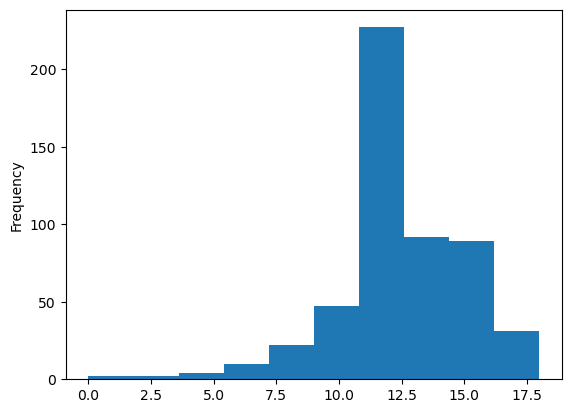
A person with no education is predicted to have an hourly wage of $-0.9. We got this result because the regression extrapolated
One more year of education is expected to increase predicted wage by $0.54
2.5 Voting Outcomes and Campaign Expenditures
wooldridge.data("vote1", description=True)name of dataset: vote1
no of variables: 10
no of observations: 173
+----------+---------------------------------+
| variable | label |
+----------+---------------------------------+
| state | state postal code |
| district | congressional district |
| democA | =1 if A is democrat |
| voteA | percent vote for A |
| expendA | camp. expends. by A, $1000s |
| expendB | camp. expends. by B, $1000s |
| prtystrA | % vote for president |
| lexpendA | log(expendA) |
| lexpendB | log(expendB) |
| shareA | 100*(expendA/(expendA+expendB)) |
+----------+---------------------------------+
From M. Barone and G. Ujifusa, The Almanac of American Politics, 1992.
Washington, DC: National Journal.
model05 = smf.ols("voteA ~ shareA", data=vote1).fit()
model05.params, model05.nobs
(Intercept 26.812214
shareA 0.463827
dtype: float64,
173.0)voteA and shareA are both percentages
one more percentage point change in shareA results in almost half percentage point increase of total vote
2.6 CEO Salary and Return on Equity
df = wooldridge.data("ceosal1")
model06 = smf.ols("salary ~ roe", data=df).fit()

df["salary_hat"] = model06.fittedvalues
df["u"] = model06.resid
df[["roe", "salary", "salary_hat", "u"]].head(10)int(df["u"].sum())0The are chosen to make sum of residuals = 0
2.7 Wage and Education
model07 = smf.ols("wage~educ", data=wage1).fit()
model07.params, model07.nobs
(Intercept -0.904852
educ 0.541359
dtype: float64,
526.0)round(wage1["educ"].mean(), 2), round(wage1["wage"].mean(), 2)(np.float64(12.56), np.float64(5.9))new_data = pd.DataFrame({"educ": [12.56]})
model07.predict(new_data)0 5.894621
dtype: float64Rergerssion equation must pass through the mean points
2.8 CEO Salary and Return on Equity
model08 = smf.ols("salary ~ roe", data=ceosal1).fit()
model08.rsquarednp.float64(0.01318862408103405)Firm return on equity explains 1.3% of the total variation in salary
2.9 Voting Outcomes and Campaign Expenditures
model09 = smf.ols("voteA ~ shareA", data=vote1).fit()
model09.rsquarednp.float64(0.8561408655827665)Share of campaign expenditures explains 85% of the variation in the election outcome
2.10 A log Wage Equation
model010 = smf.ols("np.log(wage)~educ", data=wage1).fit()
model010.params, model010.nobs, model010.rsquared
(Intercept 0.583773
educ 0.082744
dtype: float64,
526.0,
np.float64(0.18580647728823507))For every year of education, wage increases by
Note: adding log allowed to get constant percentage change interpretation
2.11 CEO Salary and Firm Sales
model011 = smf.ols("np.log(salary) ~ np.log(sales)", data=ceosal1).fit()
model011.params
Intercept 4.821996
np.log(sales) 0.256672
dtype: float64A 1% increase in firm sales increases CEO salary by about 0.257% [elasticity model]
2.12 Student Math Performance and the School Lunch Program
wooldridge.data("meap93", description=True)name of dataset: meap93
no of variables: 17
no of observations: 408
+----------+---------------------------------+
| variable | label |
+----------+---------------------------------+
| lnchprg | perc of studs in sch lnch prog |
| enroll | school enrollment |
| staff | staff per 1000 students |
| expend | expend. per stud, $ |
| salary | avg. teacher salary, $ |
| benefits | avg. teacher benefits, $ |
| droprate | school dropout rate, perc |
| gradrate | school graduation rate, perc |
| math10 | perc studs passing MEAP math |
| sci11 | perc studs passing MEAP science |
| totcomp | salary + benefits |
| ltotcomp | log(totcomp) |
| lexpend | log of expend |
| lenroll | log(enroll) |
| lstaff | log(staff) |
| bensal | benefits/salary |
| lsalary | log(salary) |
+----------+---------------------------------+
I collected these data from the old Michigan Department of Education
web site. See MATHPNL.RAW for the current web site. I used data on
most high schools in the state of Michigan for 1993. I dropped some
high schools that had suspicious-looking data.
model012 = smf.ols("math10 ~ lnchprg", data=meap93).fit()
model012.params
Intercept 32.142712
lnchprg -0.318864
dtype: float64If student eligibility in lunch program increases by 10 percentage points, his math results falls by 3.2 percentage points
Note: nonsensical data, which shows that error term is correlated with the independent variable
2.13 Heteroskedasticity in a Wage Equation
sns.lmplot(x="educ", y="wage", data=wage1, ci=None, line_kws={"color": "red"})


plt.title("Wage vs. Education (Check for Heteroscedasticity)")
plt.xlabel("Years of Education")
plt.ylabel("Wage")
plt.show()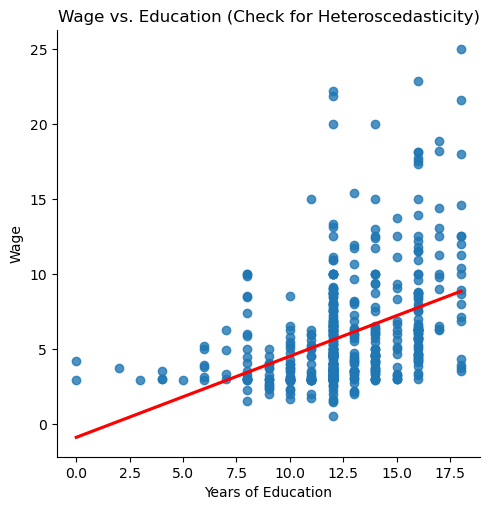
as years of education increases, variability in wage increases
2.14 Evaluating a Job Training Program
wooldridge.data("jtrain2", description=True)name of dataset: jtrain2
no of variables: 19
no of observations: 445
+----------+---------------------------------+
| variable | label |
+----------+---------------------------------+
| train | =1 if assigned to job training |
| age | age in 1977 |
| educ | years of education |
| black | =1 if black |
| hisp | =1 if Hispanic |
| married | =1 if married |
| nodegree | =1 if no high school degree |
| mosinex | # mnths prior to 1/78 in expmnt |
| re74 | real earns., 1974, $1000s |
| re75 | real earns., 1975, $1000s |
| re78 | real earns., 1978, $1000s |
| unem74 | =1 if unem. all of 1974 |
| unem75 | =1 if unem. all of 1975 |
| unem78 | =1 if unem. all of 1978 |
| lre74 | log(re74); zero if re74 == 0 |
| lre75 | log(re75); zero if re75 == 0 |
| lre78 | log(re78); zero if re78 == 0 |
| agesq | age^2 |
| mostrn | months in training |
+----------+---------------------------------+
R.J. Lalonde (1986), “Evaluating the Econometric Evaluations of
Training Programs with Experimental Data,” American Economic Review
76, 604-620. Professor Jeff Biddle, at MSU, kindly passed the data set
along to me. He obtained it from Professor Lalonde.
model014 = smf.ols("re78 ~ train", data=jtrain2).fit()
model014.params, model014.rsquared
(Intercept 4.554802
train 1.794343
dtype: float64,
np.float64(0.01782339297778035))Workers who participated in the program earned $1790 more than those who did not, OLS assumptions are met due to random assignment
shows that
Computer Problems
C1
The data in 401K are a subset of data analyzed by Papke (1995) to study the relationship between participation in a 401(k) pension plan and the generosity of the plan.
The variable prate is the percentage of eligible workers with an active account; this is the variable we would like to explain.
The measure of generosity is the plan match rate, mrate. This variable gives the average amount the firm contributes to each worker’s plan for each $1 contribution by the worker.
For example, if mrate = 0.50, then a $1 contribution by the worker is matched by a 50¢ contribution by the firm
wooldridge.data("401k", description=True)name of dataset: 401k
no of variables: 8
no of observations: 1534
+----------+---------------------------------+
| variable | label |
+----------+---------------------------------+
| prate | participation rate, percent |
| mrate | 401k plan match rate |
| totpart | total 401k participants |
| totelg | total eligible for 401k plan |
| age | age of 401k plan |
| totemp | total number of firm employees |
| sole | = 1 if 401k is firm's sole plan |
| ltotemp | log of totemp |
+----------+---------------------------------+
L.E. Papke (1995), “Participation in and Contributions to 401(k)
Pension Plans:Evidence from Plan Data,” Journal of Human Resources 30,
311-325. Professor Papke kindly provided these data. She gathered them
from the Internal Revenue Service’s Form 5500 tapes.
df = wooldridge.data("401k")
df.head()(i) Find the average participation rate and the average match rate in the sample of plans
df["prate"].mean(), df["mrate"].mean()(np.float64(87.3629074562948), np.float64(0.7315123849943027))The average prate is 87.36 and average mrate is 0.73
(II) Now, estimate the simple regression equation and report the results along with the sample size and R-squared.
model = smf.ols(formula="prate ~ mrate", data=df).fit()summary_df = pd.DataFrame(
{"term": model.params.index, "coefficient": model.params.values}
)
summary_df["nobs"] = model.nobs
summary_df["rsquared"] = model.rsquared
summary_dfThe intercept is 83.07, is 5.86, n = 1534, = 0.75
(iii) Interpret the intercept in your equation. Interpret the coefficient on mrate.
intercept = 83.75:- if mrate is zero, predicted participation rate is 83.05 mrate = 5.86:- one dollar increase in mrate will cause prate to increase by 5.86 (given the prate range allows this increase)
(iv) Find the predicted prate when mrate = 3.5. Is this a reasonable prediction? Explain what is happening here
new_data = pd.DataFrame({"mrate": [3.50]})
model.predict(new_data)
0 103.589233
dtype: float64model.params["Intercept"] + model.params["mrate"] * 3.5np.float64(103.58923260345671)if mrate = 3.5, prate = 103.5 which isn’t possible because prate is bounded by range 0 to 100
(v) How much of the variation in prate is explained by mrate? Is this a lot in your opinion?
model.rsquared * 100np.float64(7.4703098402918)The model explains 7.5% from the variation in prate, indicating the inlfuence of other factors on prate
C2
The data set in CEOSAL2 contains information on chief executive officers for U.S. corporations. The variable salary is annual compensation, in thousands of dollars, and ceoten is prior number of years as company CEO
wooldridge.data("ceosal2", description=True)name of dataset: ceosal2
no of variables: 15
no of observations: 177
+----------+--------------------------------+
| variable | label |
+----------+--------------------------------+
| salary | 1990 compensation, $1000s |
| age | in years |
| college | =1 if attended college |
| grad | =1 if attended graduate school |
| comten | years with company |
| ceoten | years as ceo with company |
| sales | 1990 firm sales, millions |
| profits | 1990 profits, millions |
| mktval | market value, end 1990, mills. |
| lsalary | log(salary) |
| lsales | log(sales) |
| lmktval | log(mktval) |
| comtensq | comten^2 |
| ceotensq | ceoten^2 |
| profmarg | profits as % of sales |
+----------+--------------------------------+
See CEOSAL1.RAW
df = wooldridge.data("ceosal2")
df.head()(i) Find the average salary and the average tenure in the sample
df["salary"].mean(), df["ceoten"].mean()(np.float64(865.8644067796611), np.float64(7.954802259887006))Average salary is $865,864. Average years is about 8 years
(ii) How many CEOs are in their first year as CEO (that is, ceoten 5 0)? What is the longest tenure as a CEO?
(df["ceoten"] == 0).sum(), df["ceoten"].max()(np.int64(5), 37)There are five CEO with ceoten = 0, Longest ceoten is 37
(iii) Estimate the simple regression model and report your results in the usual form. What is the (approximate) predicted percentage increase in salary given one more year as a CEO?
model = smf.ols(formula="np.log(salary) ~ ceoten", data=df).fit()
model.params, model.nobs, model.rsquared
(Intercept 6.505498
ceoten 0.009724
dtype: float64,
177.0,
np.float64(0.013162517743660396))One more year of ceoten will increase salary by
C3
Use the data in SLEEP75 from Biddle and Hamermesh (1990) to study whether there is a tradeoff between the time spent sleeping per week and the time spent in paid work.
We could use either variable as the dependent variable. For concreteness, estimate the model
where sleep is minutes spent sleeping at night per week and totwrk is total minutes worked during the week.
wooldridge.data("sleep75", description=True)name of dataset: sleep75
no of variables: 34
no of observations: 706
+----------+--------------------------------+
| variable | label |
+----------+--------------------------------+
| age | in years |
| black | =1 if black |
| case | identifier |
| clerical | =1 if clerical worker |
| construc | =1 if construction worker |
| educ | years of schooling |
| earns74 | total earnings, 1974 |
| gdhlth | =1 if in good or excel. health |
| inlf | =1 if in labor force |
| leis1 | sleep - totwrk |
| leis2 | slpnaps - totwrk |
| leis3 | rlxall - totwrk |
| smsa | =1 if live in smsa |
| lhrwage | log hourly wage |
| lothinc | log othinc, unless othinc < 0 |
| male | =1 if male |
| marr | =1 if married |
| prot | =1 if Protestant |
| rlxall | slpnaps + personal activs |
| selfe | =1 if self employed |
| sleep | mins sleep at night, per wk |
| slpnaps | minutes sleep, inc. naps |
| south | =1 if live in south |
| spsepay | spousal wage income |
| spwrk75 | =1 if spouse works |
| totwrk | mins worked per week |
| union | =1 if belong to union |
| worknrm | mins work main job |
| workscnd | mins work second job |
| exper | age - educ - 6 |
| yngkid | =1 if children < 3 present |
| yrsmarr | years married |
| hrwage | hourly wage |
| agesq | age^2 |
+----------+--------------------------------+
J.E. Biddle and D.S. Hamermesh (1990), “Sleep and the Allocation of
Time,” Journal of Political Economy 98, 922-943. Professor Biddle
kindly provided the data.
df = wooldridge.data("sleep75")
df.head()(i) Report your results in equation form along with the number of observations and R2. What does the intercept in this equation mean?
model = smf.ols(formula="sleep ~ totwrk", data=df).fit()
model.params, model.nobs, model.rsquared
(Intercept 3586.376952
totwrk -0.150746
dtype: float64,
706.0,
np.float64(0.10328737572903668))Intercept is 3586.4:- if someone doesn’t work, he will sleep on average 3586.4 minutes per week, or 59.7 hours per week meaning 8.5 hours per day
totwrk = -0.15:- for every minute a person spends working, his sleeping time is reduced by 0.15 minute
(ii) If totwrk increases by 2 hours, by how much is sleep estimated to fall? Do you find this to be a large effect?
model.params["totwrk"] * 120np.float64(-18.08949889427928)If a person works two more hours per week, his sleeping time will decrease by 18 minutes per week. Implying 2.57 minutes per day

C4 Use the data in WAGE2 to estimate a simple regression explaining monthly salary (wage) in terms of IQ score (IQ)
wooldridge.data("wage2", description=True)name of dataset: wage2
no of variables: 17
no of observations: 935
+----------+-------------------------------+
| variable | label |
+----------+-------------------------------+
| wage | monthly earnings |
| hours | average weekly hours |
| IQ | IQ score |
| KWW | knowledge of world work score |
| educ | years of education |
| exper | years of work experience |
| tenure | years with current employer |
| age | age in years |
| married | =1 if married |
| black | =1 if black |
| south | =1 if live in south |
| urban | =1 if live in SMSA |
| sibs | number of siblings |
| brthord | birth order |
| meduc | mother's education |
| feduc | father's education |
| lwage | natural log of wage |
+----------+-------------------------------+
M. Blackburn and D. Neumark (1992), “Unobserved Ability, Efficiency
Wages, and Interindustry Wage Differentials,” Quarterly Journal of
Economics 107, 1421-1436. Professor Neumark kindly provided the data,
of which I used just the data for 1980.
df = wooldridge.data("wage2")
df.head()(i) Find the average salary and average IQ in the sample. What is the sample standard deviation of IQ? (IQ scores are standardized so that the average in the population is 100 with a standard deviation equal to 15.)
df["wage"].mean(), df["IQ"].mean(), df["IQ"].std(ddof=1)(np.float64(957.9454545454546),
np.float64(101.28235294117647),
15.0526363702651)Average salary is $957.95, Average IQ is 101.28. Sample standard deviation for IQ is 15.05
(ii) Estimate a simple regression model where a one-point increase in IQ changes wage by a constant dollar amount. Use this model to find the predicted increase in wage for an increase in IQ of 15 points. Does IQ explain most of the variation in wage?
model = smf.ols(formula="wage ~ IQ", data=df).fit()
model.params, model.nobs, model.rsquared
(Intercept 116.991565
IQ 8.303064
dtype: float64,
935.0,
np.float64(0.09553528456778504))model.params["IQ"] * 15np.float64(124.5459646235166)According to the model results, an increase of IQ by 15 points will result into increase of salary by $124.5 IQ explains only 10% from the variation in wage
(iii) Now, estimate a model where each one-point increase in IQ has the same percentage effect on wage. If IQ increases by 15 points, what is the approximate percentage increase in predicted wage?
model = smf.ols(formula="np.log(wage) ~ IQ", data=df).fit()
model.params, model.nobs, model.rsquared
(Intercept 5.886994
IQ 0.008807
dtype: float64,
935.0,
np.float64(0.09909129613279599))model.params["IQ"] * 15 * 100np.float64(13.210734614214326)An increase of IQ by 15 points will result into increase of salary by 13.2%