3. Qualitative Explanatory Variables Regression Models#
suppressPackageStartupMessages({
  library(tidyverse)
  library(tidymodels)
  library(readxl)
  library(multcomp)
  library(car)
})
Wage function#
\(D_2\) = 1 if female, 0 for male
\(D_3\) = 1 for nonwhite, 0 for white
\(D_4\) = 1 union member, 0 non union
All \(D\) are dummy variables
df <- read_excel("data/Table1_1.xls")
head(df,3)
| obs | wage | female | nonwhite | union | education | exper | age | wind | femalenonw | lnwage | education_exper | _Ifemale_1 | _IfemXeduca_1 | _IfemXexper_1 | _Inonwhite_1 | _InonXeduca_1 |
|---|---|---|---|---|---|---|---|---|---|---|---|---|---|---|---|---|
| <dbl> | <dbl> | <dbl> | <dbl> | <dbl> | <dbl> | <dbl> | <dbl> | <dbl> | <dbl> | <dbl> | <dbl> | <dbl> | <dbl> | <dbl> | <dbl> | <dbl> |
| 1 | 11.55 | 1 | 0 | 0 | 12 | 20 | 38 | 1 | 0 | 2.446686 | 240 | 1 | 12 | 20 | 0 | 0 |
| 2 | 5.00 | 0 | 0 | 0 | 9 | 9 | 24 | 0 | 0 | 1.609438 | 81 | 0 | 0 | 0 | 0 | 0 |
| 3 | 12.00 | 0 | 0 | 0 | 16 | 15 | 37 | 1 | 0 | 2.484907 | 240 | 0 | 0 | 0 | 0 | 0 |
model <- lm(wage~ female + nonwhite + union + education + exper, data = df)
tidy(model)
glance(model)
| term | estimate | std.error | statistic | p.value |
|---|---|---|---|---|
| <chr> | <dbl> | <dbl> | <dbl> | <dbl> |
| (Intercept) | -7.1833382 | 1.01578786 | -7.071691 | 2.508276e-12 |
| female | -3.0748754 | 0.36461621 | -8.433184 | 8.939423e-17 |
| nonwhite | -1.5653133 | 0.50918754 | -3.074139 | 2.155664e-03 |
| union | 1.0959758 | 0.50607809 | 2.165626 | 3.052356e-02 |
| education | 1.3703010 | 0.06590421 | 20.792312 | 5.507613e-83 |
| exper | 0.1666065 | 0.01604756 | 10.382050 | 2.659960e-24 |
| r.squared | adj.r.squared | sigma | statistic | p.value | df | logLik | AIC | BIC | deviance | df.residual | nobs |
|---|---|---|---|---|---|---|---|---|---|---|---|
| <dbl> | <dbl> | <dbl> | <dbl> | <dbl> | <dbl> | <dbl> | <dbl> | <dbl> | <dbl> | <int> | <int> |
| 0.3233388 | 0.3207018 | 6.508137 | 122.6149 | 3.453151e-106 | 5 | -4240.37 | 8494.741 | 8530.872 | 54342.54 | 1283 | 1289 |
female dummy variable: average wage of female is lower by $3.07 as compared to average wage of a male(reference category), ceteris paribus
union dummy variable: average wage of union is higher by $1.10 as compared to average wage of non union workers, , ceteris paribus
nonwhite dummy variable: average wage of nonwhite worker is lower by $1.56 as compared to average wage of white workers, , ceteris paribus
Intercept: –7.18 isthe expected hourly wage for white, non-union, male worker
called differential intercept dummies
Refinement of the wage function#
Interactive dummy: female non white worker
model2 <- lm(wage~ female + nonwhite + union + education + exper + female*nonwhite, data = df)
tidy(model2)
glance(model2)
| term | estimate | std.error | statistic | p.value |
|---|---|---|---|---|
| <chr> | <dbl> | <dbl> | <dbl> | <dbl> |
| (Intercept) | -7.088725 | 1.01948176 | -6.953264 | 5.671212e-12 |
| female | -3.240148 | 0.39532778 | -8.196106 | 5.961063e-16 |
| nonwhite | -2.158525 | 0.74842579 | -2.884087 | 3.991105e-03 |
| union | 1.115044 | 0.50635176 | 2.202113 | 2.783489e-02 |
| education | 1.370113 | 0.06590009 | 20.790761 | 5.752227e-83 |
| exper | 0.165856 | 0.01606150 | 10.326307 | 4.560482e-24 |
| female:nonwhite | 1.095371 | 1.01289673 | 1.081424 | 2.797118e-01 |
| r.squared | adj.r.squared | sigma | statistic | p.value | df | logLik | AIC | BIC | deviance | df.residual | nobs |
|---|---|---|---|---|---|---|---|---|---|---|---|
| <dbl> | <dbl> | <dbl> | <dbl> | <dbl> | <dbl> | <dbl> | <dbl> | <dbl> | <dbl> | <int> | <int> |
| 0.3239555 | 0.3207915 | 6.507707 | 102.3875 | 2.252543e-105 | 6 | -4239.783 | 8495.565 | 8536.858 | 54293.02 | 1282 | 1289 |
Interactive dummy: Being a female has a lower salary by 3.2.
Being a nonwhite worker has a lower salary by 2.15.
Being both a female nonwhite worker has a lower salary (-3.2 - 2.15 + 1.10) = -4.25.
Another refinement of the wage function#
\begin{align} \text{wage}i &= \beta_1 + \beta_2 \text{female} + \beta_3 \text{nonwhite} +\beta_4 \text{union}+\beta_5 \text{educ}\ &+\beta_6 \text{exper} +\beta_7( \text{female * Educ}) +\beta_8 (\text{nonwhite * Educ}) \ &+\beta_9 (\text{union * Educ}) +\beta{10} (\text{female * exper}) +\beta_{11} (\text{nonwhite * exper})\ &+ \beta_{12} (\text{union * exper}) + u_i \end{align}
\(\beta_2, \beta_3, \beta_4\) are diferential intercept dummies
\(\beta_7 \to \beta_{11}\) are differential slope dummies
model3 <- lm(wage~ female + nonwhite + union + education + exper +
             female*education + female*exper +
             nonwhite*education + nonwhite*exper +
             union*education + union*exper, data = df)
tidy(model3)
glance(model3)
| term | estimate | std.error | statistic | p.value |
|---|---|---|---|---|
| <chr> | <dbl> | <dbl> | <dbl> | <dbl> |
| (Intercept) | -11.09128575 | 1.42184620 | -7.8006227 | 1.272876e-14 |
| female | 3.17415751 | 1.96646494 | 1.6141440 | 1.067433e-01 |
| nonwhite | 2.90912852 | 2.78006592 | 1.0464243 | 2.955632e-01 |
| union | 4.45421150 | 2.97349392 | 1.4979723 | 1.343876e-01 |
| education | 1.58712500 | 0.09381936 | 16.9168183 | 4.408735e-58 |
| exper | 0.22091235 | 0.02510676 | 8.7989186 | 4.394876e-18 |
| female:education | -0.33688760 | 0.13199299 | -2.5523143 | 1.081657e-02 |
| female:exper | -0.09612482 | 0.03181329 | -3.0215303 | 2.565047e-03 |
| nonwhite:education | -0.32185517 | 0.19534842 | -1.6475954 | 9.968173e-02 |
| nonwhite:exper | -0.02204137 | 0.04437560 | -0.4967001 | 6.194861e-01 |
| union:education | -0.19832332 | 0.19137307 | -1.0363178 | 3.002501e-01 |
| union:exper | -0.03345389 | 0.04605375 | -0.7264096 | 4.677208e-01 |
| r.squared | adj.r.squared | sigma | statistic | p.value | df | logLik | AIC | BIC | deviance | df.residual | nobs |
|---|---|---|---|---|---|---|---|---|---|---|---|
| <dbl> | <dbl> | <dbl> | <dbl> | <dbl> | <dbl> | <dbl> | <dbl> | <dbl> | <dbl> | <int> | <int> |
| 0.3328109 | 0.3270637 | 6.477589 | 57.90909 | 3.562619e-104 | 11 | -4231.285 | 8488.569 | 8555.67 | 53581.84 | 1277 | 1289 |
female*experience: for each additional year of experience, the increase in income for females is 0.09 units less than for males.
Functional form of wage regression#
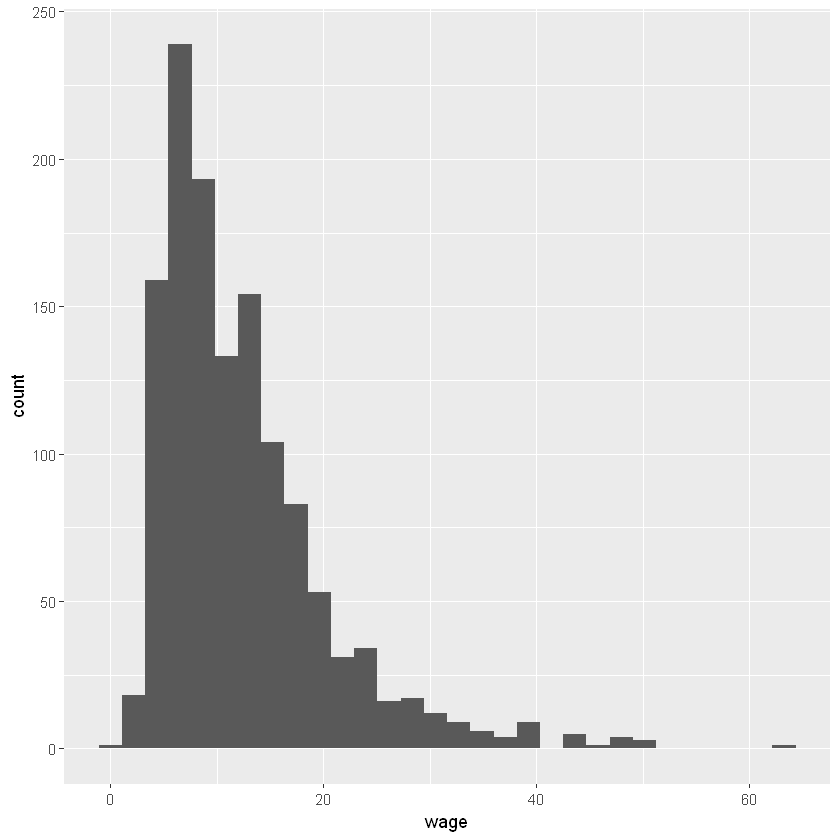
summary(df$wage)

ggplot(df, aes(x = wage))+
        geom_histogram(bins = 30)

shapiro.test(df$wage)
   Min. 1st Qu.  Median    Mean 3rd Qu.    Max.
   0.84    6.92   10.08   12.37   15.63   64.08
	Shapiro-Wilk normality test

data:  df$wage
W = 0.84488, p-value < 2.2e-16
library(moments)
skewness(df$wage)
kurtosis(df$wage)
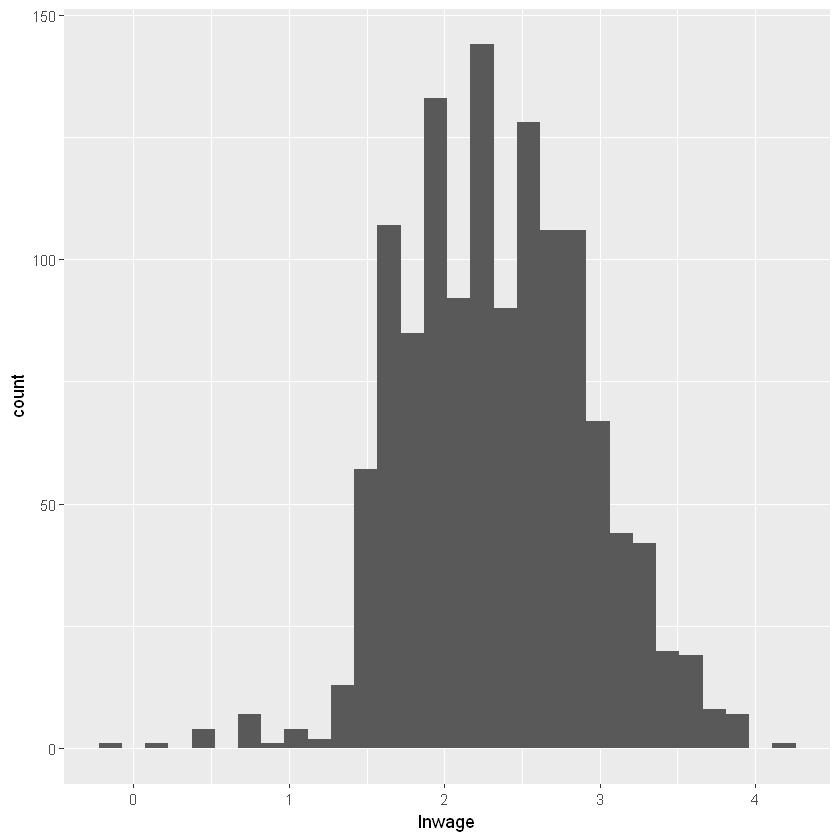
summary(df$lnwage)
skewness(df$lnwage)
kurtosis(df$lnwage)

ggplot(df, aes(x = lnwage))+
        geom_histogram(bins = 30)
   Min. 1st Qu.  Median    Mean 3rd Qu.    Max.
-0.1744  1.9344  2.3106  2.3424  2.7492  4.1601
library('tseries')
jarque.bera.test(df$lnwage)
shapiro.test(df$lnwage)
Registered S3 method overwritten by 'quantmod':
  method            from
  as.zoo.data.frame zoo
	Jarque Bera Test

data:  df$lnwage
X-squared = 2.7899, df = 2, p-value = 0.2478
	Shapiro-Wilk normality test

data:  df$lnwage
W = 0.99175, p-value = 1.268e-06
model4 <-  lm(lnwage~ female + nonwhite + union + education + exper, data = df)
tidy(model4)
glance(model4)
| term | estimate | std.error | statistic | p.value |
|---|---|---|---|---|
| <chr> | <dbl> | <dbl> | <dbl> | <dbl> |
| (Intercept) | 0.90550368 | 0.074174901 | 12.207683 | 1.662727e-32 |
| female | -0.24915404 | 0.026625019 | -9.357891 | 3.511043e-20 |
| nonwhite | -0.13353510 | 0.037181913 | -3.591399 | 3.413335e-04 |
| union | 0.18020354 | 0.036954854 | 4.876316 | 1.216066e-06 |
| education | 0.09987030 | 0.004812460 | 20.752442 | 1.025031e-82 |
| exper | 0.01276009 | 0.001171825 | 10.889073 | 1.795174e-26 |
| r.squared | adj.r.squared | sigma | statistic | p.value | df | logLik | AIC | BIC | deviance | df.residual | nobs |
|---|---|---|---|---|---|---|---|---|---|---|---|
| <dbl> | <dbl> | <dbl> | <dbl> | <dbl> | <dbl> | <dbl> | <dbl> | <dbl> | <dbl> | <int> | <int> |
| 0.3456505 | 0.3431004 | 0.4752374 | 135.5452 | 1.738922e-115 | 5 | -867.0651 | 1748.13 | 1784.261 | 289.7663 | 1283 | 1289 |
education coefficient of 0.0999 suggests that for every additional year of schooling, the average wage rate goes up by about 9.99%, ceteris paribus
female dummy coefficient of –0.2492 as suggesting that the average female wage rate is lower by 24.92% as compared to the male average wage rate. (approximately)
(exp(-0.2492) - 1) * 100
average female wage rate is lower by 22% as compared to the male average wage rate. (exact)
Dummy variables in structural change#
GPS: gross private savings
GPI: gross private investments
df2 <- read_excel("data/Table3_6.xls")
head(df2,3)
| obs | gpi | gps | recession81 | gpsrec81 |
|---|---|---|---|---|
| <dbl> | <dbl> | <dbl> | <dbl> | <dbl> |
| 1959 | 78.5 | 84.6 | 0 | 0 |
| 1960 | 78.9 | 84.8 | 0 | 0 |
| 1961 | 78.2 | 91.8 | 0 | 0 |
model5 <- lm(gpi ~ gps, data = df2)
tidy(model5)
glance(model5)
| term | estimate | std.error | statistic | p.value |
|---|---|---|---|---|
| <chr> | <dbl> | <dbl> | <dbl> | <dbl> |
| (Intercept) | -78.721047 | 27.48474252 | -2.864173 | 6.230637e-03 |
| gps | 1.107395 | 0.02907993 | 38.081092 | 5.567391e-37 |
| r.squared | adj.r.squared | sigma | statistic | p.value | df | logLik | AIC | BIC | deviance | df.residual | nobs |
|---|---|---|---|---|---|---|---|---|---|---|---|
| <dbl> | <dbl> | <dbl> | <dbl> | <dbl> | <dbl> | <dbl> | <dbl> | <dbl> | <dbl> | <int> | <int> |
| 0.9686074 | 0.9679395 | 114.8681 | 1450.17 | 5.567391e-37 | 1 | -300.9524 | 607.9049 | 613.5803 | 620149.8 | 47 | 49 |
if GPS increases by a dollar, the average GPI goes up by about $1.10.
Check for structural break#
GPS: gross private savings
GPI: gross private investments
Recession81: 0 before year 1981, 1 afterwords
model6 <- lm(gpi ~ gps + recession81, data = df2)
tidy(model6)
glance(model6)
| term | estimate | std.error | statistic | p.value |
|---|---|---|---|---|
| <chr> | <dbl> | <dbl> | <dbl> | <dbl> |
| (Intercept) | -83.486025 | 23.15912656 | -3.604887 | 7.649795e-04 |
| gps | 1.288672 | 0.04706553 | 27.380380 | 4.045379e-30 |
| recession81 | -240.787848 | 53.39662813 | -4.509420 | 4.464419e-05 |
| r.squared | adj.r.squared | sigma | statistic | p.value | df | logLik | AIC | BIC | deviance | df.residual | nobs |
|---|---|---|---|---|---|---|---|---|---|---|---|
| <dbl> | <dbl> | <dbl> | <dbl> | <dbl> | <dbl> | <dbl> | <dbl> | <dbl> | <dbl> | <int> | <int> |
| 0.9782308 | 0.9772843 | 96.68906 | 1033.538 | 5.893647e-39 | 2 | -291.9836 | 591.9672 | 599.5345 | 430043.7 | 46 | 49 |
Intercept pre recession: -83
Intercept post recession: (-83-240) = -324
To check for slope:
model7 <- lm(gpi ~ gps + recession81 + gps*recession81, data = df2)
tidy(model7)
glance(model7)
| term | estimate | std.error | statistic | p.value |
|---|---|---|---|---|
| <chr> | <dbl> | <dbl> | <dbl> | <dbl> |
| (Intercept) | -7.7798689 | 38.4495931 | -0.2023394 | 8.405634e-01 |
| gps | 0.9510818 | 0.1474505 | 6.4501785 | 6.686678e-08 |
| recession81 | -357.4586528 | 70.2863017 | -5.0857513 | 6.910536e-06 |
| gps:recession81 | 0.3719201 | 0.1547662 | 2.4031102 | 2.044029e-02 |
| r.squared | adj.r.squared | sigma | statistic | p.value | df | logLik | AIC | BIC | deviance | df.residual | nobs |
|---|---|---|---|---|---|---|---|---|---|---|---|
| <dbl> | <dbl> | <dbl> | <dbl> | <dbl> | <dbl> | <dbl> | <dbl> | <dbl> | <dbl> | <int> | <int> |
| 0.9807067 | 0.9794205 | 92.03045 | 762.4731 | 1.42319e-38 | 3 | -289.0255 | 588.051 | 597.5101 | 381132.2 | 45 | 49 |
GPI pre recession: -7.78 + 0.95 GPS
GPI post recession: (-7.78 - 357.45) + (0.95 + 0.37) GPS
Dummy variables in seasonal data (deseasonalization)#
df3 <- read_excel("data/Table3_10.xls")
head(df3,3)
| obs | sales | rpdi | conf | d2 | d3 | d4 | lnsales | yearq | trend |
|---|---|---|---|---|---|---|---|---|---|
| <chr> | <dbl> | <dbl> | <dbl> | <dbl> | <dbl> | <dbl> | <dbl> | <dbl> | <dbl> |
| 1986:1 | 53.714 | 84.18 | 286.6 | 0 | 0 | 0 | 3.983674 | 21916 | 1 |
| 1986:2 | 71.501 | 85.04 | 290.3 | 1 | 0 | 0 | 4.269711 | 21916 | 2 |
| 1986:3 | 96.374 | 84.57 | 284.5 | 0 | 1 | 0 | 4.568236 | 21916 | 3 |
\(D_2\) = 1 for second quarter
\(D_3\) = 1 for third quarter
\(D_4\) = 1 for fourth quarter
model8 <- lm(sales ~  d2 + d3 + d4, data = df3)
tidy(model8)
glance(model8)
| term | estimate | std.error | statistic | p.value |
|---|---|---|---|---|
| <chr> | <dbl> | <dbl> | <dbl> | <dbl> |
| (Intercept) | 73.18343 | 3.977483 | 18.399433 | 1.178376e-15 |
| d2 | 14.69229 | 5.625010 | 2.611957 | 1.528526e-02 |
| d3 | 27.96472 | 5.625010 | 4.971496 | 4.468310e-05 |
| d4 | 57.11472 | 5.625010 | 10.153709 | 3.646049e-10 |
| r.squared | adj.r.squared | sigma | statistic | p.value | df | logLik | AIC | BIC | deviance | df.residual | nobs |
|---|---|---|---|---|---|---|---|---|---|---|---|
| <dbl> | <dbl> | <dbl> | <dbl> | <dbl> | <dbl> | <dbl> | <dbl> | <dbl> | <dbl> | <int> | <int> |
| 0.8234883 | 0.8014244 | 10.52343 | 37.32278 | 3.372103e-09 | 3 | -103.4731 | 216.9462 | 223.6072 | 2657.822 | 24 | 28 |
Interpretation ofD2 is that the mean sales value in the second quarter is greater than the mean sales in the first, or reference, quarter by 14.69229 units; the actual mean sales value in the second quarter is (73.18343 + 14.69229) = 87.87572.
Deseasonalize#
obtain estimated sales volume
obtain residuals (actual sales - estimated sales)
add mean value of sales to residuals
augmented <- augment(model8)
augmented <- augmented %>%
mutate(deseasonalized_sales = .resid + mean(augmented$sales))
head(augmented)
| sales | d2 | d3 | d4 | .fitted | .resid | .hat | .sigma | .cooksd | .std.resid | deseasonalized_sales |
|---|---|---|---|---|---|---|---|---|---|---|
| <dbl> | <dbl> | <dbl> | <dbl> | <dbl> | <dbl> | <dbl> | <dbl> | <dbl> | <dbl> | <dbl> |
| 53.714 | 0 | 0 | 0 | 73.18343 | -19.469427 | 0.1428571 | 9.814778 | 0.166390008 | -1.9983394 | 78.65693 |
| 71.501 | 1 | 0 | 0 | 87.87571 | -16.374714 | 0.1428571 | 10.097357 | 0.117697809 | -1.6806985 | 81.75164 |
| 96.374 | 0 | 1 | 0 | 101.14814 | -4.774144 | 0.1428571 | 10.695856 | 0.010004880 | -0.4900175 | 93.35221 |
| 125.041 | 0 | 0 | 1 | 130.29814 | -5.257143 | 0.1428571 | 10.684361 | 0.012131669 | -0.5395925 | 92.86921 |
| 78.610 | 0 | 0 | 0 | 73.18343 | 5.426573 | 0.1428571 | 10.680063 | 0.012926240 | 0.5569827 | 103.55293 |
| 89.609 | 1 | 0 | 0 | 87.87571 | 1.733287 | 0.1428571 | 10.742676 | 0.001318749 | 0.1779044 | 99.85964 |
Expanded sales function#
Frisch_Waugh Theorem
model9 <- lm(sales ~  rpdi + conf+ d2 + d3 + d4, data = df3)
tidy(model9)
glance(model9)
| term | estimate | std.error | statistic | p.value |
|---|---|---|---|---|
| <chr> | <dbl> | <dbl> | <dbl> | <dbl> |
| (Intercept) | -152.9292193 | 52.59149307 | -2.907870 | 8.156667e-03 |
| rpdi | 1.5989033 | 0.37015528 | 4.319547 | 2.764247e-04 |
| conf | 0.2939096 | 0.08437568 | 3.483344 | 2.106581e-03 |
| d2 | 15.0452205 | 4.31537708 | 3.486421 | 2.091102e-03 |
| d3 | 26.0024741 | 4.32524385 | 6.011794 | 4.741138e-06 |
| d4 | 60.8722628 | 4.42743714 | 13.748871 | 2.795431e-12 |
| r.squared | adj.r.squared | sigma | statistic | p.value | df | logLik | AIC | BIC | deviance | df.residual | nobs |
|---|---|---|---|---|---|---|---|---|---|---|---|
| <dbl> | <dbl> | <dbl> | <dbl> | <dbl> | <dbl> | <dbl> | <dbl> | <dbl> | <dbl> | <int> | <int> |
| 0.9053748 | 0.883869 | 8.047637 | 42.09922 | 1.53222e-10 | 5 | -94.74461 | 203.4892 | 212.8146 | 1424.818 | 22 | 28 |
Piecewise Linear Regression#
introduce threshold (knot)
df4 <- read_excel("data/Table3_16.xls")
head(df4)
| obs | avgcost | lotsize | z | d | zd |
|---|---|---|---|---|---|
| <dbl> | <dbl> | <dbl> | <dbl> | <dbl> | <dbl> |
| 1 | 9.73 | 100 | -100 | 0 | 0 |
| 2 | 9.61 | 120 | -80 | 0 | 0 |
| 3 | 8.15 | 140 | -60 | 0 | 0 |
| 4 | 6.98 | 160 | -40 | 0 | 0 |
| 5 | 5.87 | 180 | -20 | 0 | 0 |
| 6 | 4.98 | 200 | 0 | 0 | 0 |
ggplot(df4, aes(x = lotsize, y = avgcost)) +
geom_point()
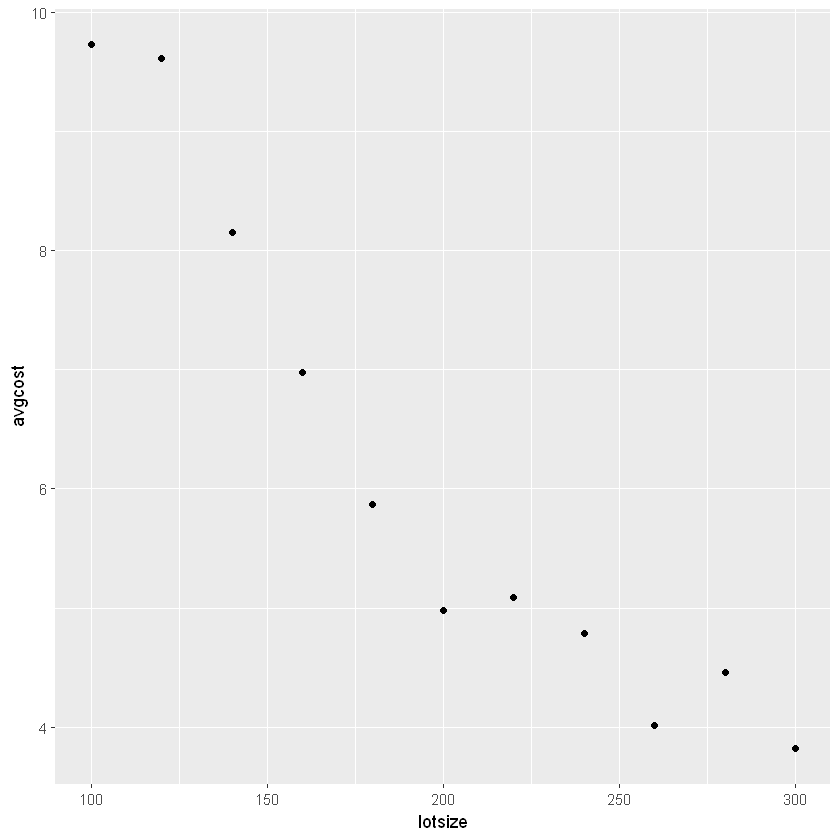
Y = average production cost,
X = lot size,
X* = threshold value of lot size,
D = 1 if Xi > X*
D = 0 if Xi < X
model10 <- lm(avgcost ~ lotsize, data = df4)
tidy(model10)
glance(model10)
| term | estimate | std.error | statistic | p.value |
|---|---|---|---|---|
| <chr> | <dbl> | <dbl> | <dbl> | <dbl> |
| (Intercept) | 12.29090855 | 0.749146219 | 16.406555 | 5.167361e-08 |
| lotsize | -0.03077273 | 0.003571414 | -8.616397 | 1.217549e-05 |
| r.squared | adj.r.squared | sigma | statistic | p.value | df | logLik | AIC | BIC | deviance | df.residual | nobs |
|---|---|---|---|---|---|---|---|---|---|---|---|
| <dbl> | <dbl> | <dbl> | <dbl> | <dbl> | <dbl> | <dbl> | <dbl> | <dbl> | <dbl> | <int> | <int> |
| 0.8918819 | 0.8798688 | 0.7491462 | 74.2423 | 1.217549e-05 | 1 | -11.3276 | 28.65521 | 29.84889 | 5.050981 | 9 | 11 |
model10 <- lm(avgcost ~ lotsize + zd, data = df4)
tidy(model10)
glance(model10)
| term | estimate | std.error | statistic | p.value |
|---|---|---|---|---|
| <chr> | <dbl> | <dbl> | <dbl> | <dbl> |
| (Intercept) | 15.11647994 | 0.535382569 | 28.234912 | 2.674940e-09 |
| lotsize | -0.05019853 | 0.003332127 | -15.065011 | 3.726359e-07 |
| zd | 0.03885161 | 0.005945966 | 6.534112 | 1.814740e-04 |
| r.squared | adj.r.squared | sigma | statistic | p.value | df | logLik | AIC | BIC | deviance | df.residual | nobs |
|---|---|---|---|---|---|---|---|---|---|---|---|
| <dbl> | <dbl> | <dbl> | <dbl> | <dbl> | <dbl> | <dbl> | <dbl> | <dbl> | <dbl> | <int> | <int> |
| 0.9829381 | 0.9786727 | 0.3156508 | 230.4409 | 8.474347e-08 | 2 | -1.172523 | 10.34505 | 11.93663 | 0.7970835 | 8 | 11 |
lot size < 200
Average cost = 15.1164 – 0.0502 lot size,
lot size > 200
Average cost = (15.1164 – 0.0385 × 200) + (–0.0502 + 0.0388) lot size
= 7.4164 – 0.0114 lot size,
up to a lot size of 200 units, the unit cost decreases by 5 cents per unit increase in the lot size, but beyond the lot size of 200 units, it decreases only by about 1 cent
Exercises#
🚧 Under Construction